

You told yourself this time would be different. You’d speak up in the Monday meeting instead of swallowing your idea. You’d stop saying yes to every request.
And you’d stop checking whether everyone else was okay before checking on yourself.
For a week or two, you did. Then a tense moment came up. Before you’d even made a decision, the old you was back in the driver’s seat.
If you’ve been wondering how to become a new version of yourself, here’s the honest answer: it usually isn’t a willpower problem. Most of us keep acting in line with the picture we hold of who we are. Change the behavior without changing that picture, and the behavior tends to snap back.
The good news is that the picture can change. Below, we’ll look at why the old you keeps returning and what that looks like day to day. Then we’ll walk through five practical ways to make the new version of you stick.
Why change keeps snapping back to the old you
Most advice about change focuses on habits, routines, and discipline. Those matter. But there’s a layer underneath them that’s easy to miss: the way you see yourself.
A surgeon noticed something his scalpel couldn’t fix
Dr. Maxwell Maltz was a cosmetic surgeon. Over the years, he noticed that changing a patient’s face didn’t always change how that person felt about themselves.
Some patients gained confidence after surgery. Others kept seeing themselves exactly the way they always had.
In his 1960 book Psycho-Cybernetics, Maltz argued that the missing piece was the self-image. That’s the mental picture each of us carries of the kind of person we are.
He believed self-image is the cornerstone of personal change. We tend to act, feel, and perform in ways that match it.
To be clear, Maltz was writing from his own clinical observations, not from controlled studies. Still, his core idea lines up with what psychologists have studied since.
We look for proof that we are who we think we are
Psychologist William Swann developed what’s called self-verification theory. It holds that people want others to see them the way they see themselves, and they take active steps to make that happen. That’s true even when their view of themselves is negative.
In everyday terms, say you see yourself as “the one who doesn’t make waves.” You may keep steering toward jobs, situations, and relationships that confirm it. Not because you want to stay small, but because the familiar picture feels like home.
It takes longer than 21 days
You’ve probably heard that it takes 21 days to form a habit. That idea is often traced back to Maltz. He wrote that it takes a minimum of about 21 days for an old mental image to dissolve and a new one to form.
Somewhere along the way, “a minimum” for a self-image turned into a deadline for habits.
Phillippa Lally’s team at University College London tested how long habits really take. People needed an average of 66 days for a new daily behavior to feel automatic, and the time varied widely from person to person.
A later article by the same research group calls the 21-day figure a myth. It traces it back to stories about plastic surgery patients.
What this means when you’re trying to change
Put these ideas together and a pattern shows up. When change doesn’t stick, we’ve often tried to change what we do while still seeing ourselves the old way. Then we gave up long before the new way had time to settle in.
Rob Dial makes a related point in his September 2026 episode You Need to Let Your Old Self Die. He talks about why we stay loyal to an old identity and the grief that can come with letting it go. He also makes the point that real transformation takes years, not weeks.
My perspective: from playing small to showing up as me
For a long time, I made myself small on purpose. At work in IT and in my personal life, I believed my job was not to shine too bright. I didn’t want anyone to feel uncomfortable or threatened by me.
I looked for outside validation and needed other people’s approval to feel good about myself. Somewhere along the way, I decided my role was to make others feel better about themselves and to babysit their emotions.
If any part of that sounds familiar, you’re not alone. And it isn’t a flaw in who you are.
Through my personal development journey, I realized that version of me was an identity I built at a young age to feel safe. It wasn’t who I truly am. It kept me unhappy, stuck, and playing small, and it led me to abandon myself in ways I couldn’t see at the time.
Part of what helped was understanding my own patterns. Once I learned my growth archetype, I could see how I tend to get stuck and what actually helps me move forward. The old identity got much easier to spot, and much easier to let go of.
If you’ve ever wondered what your own patterns are, the free Growth Archetype Quiz is a gentle place to start.
Seeing that clearly set me free. I’m letting go of the old version of me so I can become who God, my higher self, or the universe wants me to become.
Who I am now
Today, I show up for myself. I’m less self-critical and more accepting of who I am, flaws and all. My self-love and self-confidence have grown, and I can feel the difference.
I set boundaries with confidence. I speak up at work and outside of it when something needs to be said. I no longer need anyone’s approval to know I’m on the right path.
I’ve also stepped away from situations and environments that no longer support my well-being and growth.
My career has followed. I used to attract and accept jobs that required me to perform as my old identity. Now I’m choosing positions that reinforce the person I’ve become.
I’m not who I was, and I’m proud of who I’m becoming. If I could change the way I see myself, so can you.
Signs you’re still living by an old self-image
None of these is a diagnosis. They’re patterns a lot of people recognize once they start paying attention. Notice which ones feel familiar.
1. You change your situation, but the pattern follows you
New job, same overcommitting. New team, same role as the person who smooths everything over. When the setting changes but the story doesn’t, the old self-image is usually still in charge.
2. You still describe yourself with old labels
“I’m not a leader.” “I’m just the IT person.” “I’m bad with confrontation.” Labels like these often started as observations and quietly turned into rules.
3. Wins feel like they belong to someone else
You get the promotion or the praise, and right away it feels like luck. Part of you waits for someone to figure out you don’t deserve it. The achievement doesn’t match the picture, so it never quite sinks in.
4. You hold back right before something good happens
You don’t share the idea. You downplay what you did. You talk yourself out of applying.
Shrinking can feel safer than standing out, especially if standing out once came with a cost.
5. Under stress, you slide back into the old role
When things get tense, you become the fixer, the peacekeeper, or the one managing everyone else’s feelings. Stress tends to pull us toward whatever feels most familiar.
6. You wait for permission to change
You want someone to approve of the new you before you’ll act like it. But the approval rarely comes first. It usually follows the change.
7. You keep ending up in places built for the old you
Jobs, friendships, or environments that only work if you stay the way you were. If that keeps happening, it may be less about bad luck and more about the picture you’re still carrying.
The old picture was built for a reason
Most self-images aren’t random. Many of them were built early, and often for good reasons.
Maybe you were the agreeable one. The one who never outshined anyone. The one who kept everyone comfortable. At the time, that may have been a smart way to stay safe, earn approval, or avoid conflict.
The trouble is that a strategy that protected a kid can quietly keep running an adult’s life. The same goes for the younger you at your first job. You can be capable and accomplished and still be living from a picture of yourself drawn decades ago.
That’s why certain questions can feel so unsettling. “Who am I if I’m not my job?” “Who am I if I’m not the one keeping everyone happy?”
When a role has felt like your identity for a long time, stepping out of it can feel like losing yourself. More often, it’s the start of finding out who you are underneath it.
If you read my last post, You’re Good at Your Job and Don’t Care Anymore, this may sound familiar. Sometimes the job hasn’t changed at all. You have.
How to become a new version of yourself (and make it stick)
You don’t need a dramatic reinvention. You need a clearer picture, small proof, and more patience than most advice admits.
1. Write down the old picture
Finish the sentence “I’m the kind of person who…” five times, as honestly as you can. Then, next to each one, note where it came from. Did you choose it, or did you learn it to stay safe, fit in, or be liked?
You can’t update a self-image you’ve never looked at. Once those rules are on paper, they become something you can question instead of something you automatically obey.
2. Describe the next version in actions, not adjectives
“Confident” is hard to practice. “Shares my idea in the first ten minutes of the meeting” isn’t. Write down three things the next version of you does in an ordinary week.
Concrete actions give you something specific to practice, and a clear way to notice when you’ve done it.
3. Rehearse it before you live it
Maltz called this the “theater of the mind.” Take a few quiet minutes to picture a specific moment coming up. It might be a meeting, a hard conversation, or a request you’d usually say yes to.
Now see yourself handling it the new way. Notice what you say, how you sound, and how you respond if someone pushes back.
This isn’t about wishing an outcome into existence. It’s closer to a rehearsal, the way a speaker practices a talk before giving it. It works best when you follow it with the real thing.
4. Plan for the moment you usually slip
Pick the situation where the old you most often takes over and decide in advance what you’ll do. For example: “If my manager asks me to take on something that will overload me, then I’ll say, ‘Let me check my priorities and get back to you today.'”
Psychologists call these implementation intentions. Peter Gollwitzer and Paschal Sheeran reviewed 94 independent tests of them. They found these simple if-then plans had a medium-to-large positive effect on reaching goals.
5. Give it time, and treat slips as information
If 66 days is the average for a simple habit, a deeper shift in how you see yourself deserves at least that much patience.
The good news from the same UCL research: missing one opportunity didn’t significantly hurt the habit-forming process. What got in the way was being very inconsistent.
So when you slip back into the old you, skip the verdict. Ask what triggered it, adjust your plan, and start again the next day.
The old you may visit. That doesn’t mean it gets to move back in.
One more thing. Some old patterns are tied to painful experiences, or come with ongoing anxiety or low mood. If that’s true for you, a licensed therapist can help you work through them. That’s a strength, not a setback.
One question to sit with
If the next version of you were already living your week, what’s one thing they would do differently tomorrow?
Write it down. Then do that one thing. Small proof counts.
Want a guided way to do this?
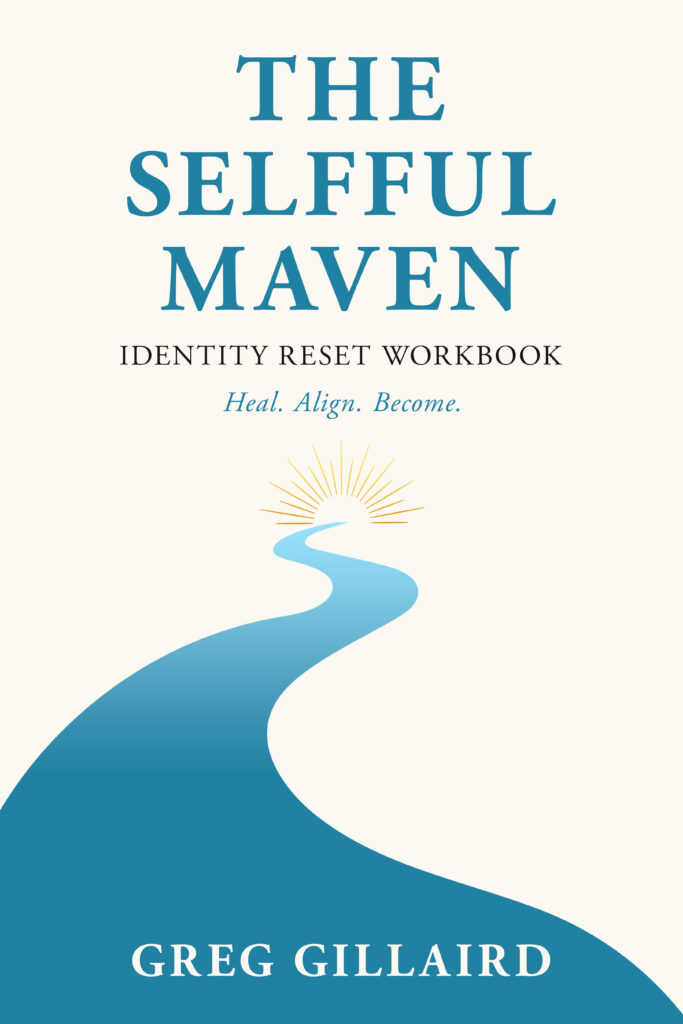
Sometimes you want more structure than a blog post can give. The Selfful Maven Identity Reset Workbook is built for exactly this kind of work.
It gives you a guided space to get honest about the identity you’ve been living from. Then it helps you start shaping the one you’re growing into, at your own pace.
Get the Identity Reset Workbook
Closing thoughts
Becoming a new version of yourself isn’t about forcing yourself to be someone else. It’s about letting go of a picture you outgrew a long time ago.
Maltz noticed it more than 60 years ago: when the self-image stays the same, behavior tends to drift back to match it. Newer research adds the part we’d rather not hear. It takes patience, practice, and usually a lot longer than 21 days.
That’s what I’ve come to believe: feeling stuck is often less about discipline and more about identity. You’ve outgrown who you had to become.
The version of you that played small, kept the peace, or chased approval got you here. It deserves some gratitude. It just doesn’t get to make the decisions anymore.
You don’t have to become someone new overnight. You just have to stop living as someone you’ve already outgrown.
Frequently asked questions
Yes, though it usually happens gradually. Your self-image was learned, which means it can be relearned.
Most people don’t notice one big turning point. Months later, they realize something that once felt impossible, like setting a boundary, now feels normal. Small, consistent actions, honest reflection, and supportive people all make that shift more likely.
Usually not. The 21-day idea is often traced to Maxwell Maltz. He wrote about a minimum of about 21 days for a self-image to start shifting, not a deadline for habits.
Research from University College London found new daily habits took an average of 66 days to feel automatic, with wide differences between people. So if day 22 arrives and it still feels hard, you’re not failing. You’re right on schedule.
Old habits are tied to familiar cues and to how you see yourself. Under stress, your mind reaches for what it knows best.
A slip doesn’t erase your progress. Research on habit formation found that missing one opportunity didn’t significantly set people back. Notice what triggered the slip, make an if-then plan for next time, and keep going.
It can be, if you only picture the result and stop there. Mental rehearsal is different.
Instead of imagining the reward, you practice the specific actions: what you’ll say in the meeting, or how you’ll respond when someone pushes back. Used that way, it’s preparation, not wishing. It works best when you follow it with real practice.
Expect some pushback. People get used to who you’ve been. Change can make them uncomfortable, especially if they benefited from the old version of you. Explain briefly if you want to, then keep showing up consistently. Some relationships will adjust over time, and others may fade. That can be a natural part of growth. Look for people who support who you’re becoming.